Friday, December 11, 2009

A society's collective social consciousness is formed by the more commonly known narratives that exist within it. It's how popular media is able to actively shape ideology - media, and particularly advertisements, are everywhere.

Soap advertisers in the Industrial Era considered themselves both builders of empires and carrying out the imperial mission, a consideration that marks the shift from small business to imperial monopolies. We discussed how they were able to change the perception of human hygiene, giving importance to being clean, and creating a new way to distinguish social and economic differences. Their success, I think, can be measured by how importantly we hold hygiene to the point where it has become an obsession.

Any quick survey of TV shows, movies, advertisements, etc. show this obsession - hospitals on shows like Grey's Anatomy, ER, and House are always super clean, super sterile environments (at least in appearance). Even the people on these shows are clean, they're pretty people without imperfections. And in movies and shows that feature New York, a place we know so well to be quite dirty, public places like subway stations, cars, the street, etc. are all so clean. CSI NY I think is a great example of this. To begin with the show is rather scientific, there's a level of scientific spectacle that goes hand in hand with hygiene. The "grittyness" of the show is always on a much cleaner level than reality.

Thursday, December 10, 2009

Bodies


As soon as started discussing the bodies exhibit in class, i thought of the hottentot people and or discussion about the "analytical studies" done to the black people. Back in the day, it was thought that Black people had a different anatomy than white people so they were put through tests, dissected, and made into a spectacle. In this picture, you can see that all the white people staring at the one black person in the center who has an enormous butt. they are viewing her from all angles and probably commenting on how peculiar and interesting she is. Sound familiar? If you walk into the bodies exhibit you will hear words like "fascinating!" and "disgusting" all at the same time, and I am pretty sure its not a stretch to say that the white people in the picture are doing the exact same thing. We constantly need a spectacle - something to make ourselves feel normal and superior. Its okay, we can stare at these dead chinese prisoners because their lives probably sucked anyway and in their death they're contributing to "science." While we may feel we have evolved in terms of human and civil rights, have we really? there will always be something new and something undiscovered for us to exploit and manipulate for our own benefit. We can dress it up and place it under the term "science," but there is no actual scientific study done in this exhibit. it is pure and simply, an exhibition. We need to be weary of exploitative spectacles like the body exhibit that are prevalent in our society. And if anyone gets the chance to go to the bodies exhibit, try and remember that these "bodies" were once people.

Sex and Science: Good Match?

Corporations use a variety of tactics to convince us to buy their product. One of which we talked about is science.
Science, which involves repetitive experimentation to gain evidence (often expressed in quantifiable terms), adds legitimacy to any argument. Numbers say it all, and if we find out that things have been tried and tested, all the more we are convinced.
I've seen these ads everywhere (mostly subway stations on my way uptown) -- these new athletic shoes that aid in weight loss.
The new EasyTone walking shoe, a provocative new marketing campaign says, "leaves leg and buttock muscles better toned than regular walking shoes." Officials from Reebok, a unit of Adidas, say the EasyTone is the company’s most successful new product in at least five years.
Isn't that common sense though? Shoes are associated with walking, and walking burns calories. You don't have to be a scientist to figure that out.
The selling point lies in the design.
"Balance pods" added to the toe and heel of the shoe requires the person to do more work to control balance and engage the muscle. The effect, apparently, is like walking on a sandy beach.
Let's see this for ourselves:


Again with the "sex sells" theme! And they're very consistent at that: in one commercial for the shoe, the camera drifts away from the woman’s face and zooms in on her backside. Another ad claims that the leg and butt-toning effects of EasyTone will "make your boobs jealous."
Who knew, science and sex make for a good marriage. Nice comeback, Reebok (Reebok's been dead to me for a while).
Another thing I'd like to point out is the fact that THESE ARE NOT MEANT FOR USE AT THE GYM, or for running. They're meant for walking.
So as you strut around with the "perfect ass," you're wearing sneakers. I don't know about you, but sneakers to me are not sexy (Vanessa Hudgens attempted to market Ecko shoes as such -- see "Sneakernight" video). So it's really interesting how Reebok TRIES to make very unglamorous-looking shoes ultra-feminine and erotic.

The Body

We recently discussed the human body and our obsession with death, sexuality and dissection. The creation of life has also come with the questions and uncertainty of death. People have put other species on exhibit for thousands of years. One specific example is the spectacle of live action and death with the Gladiators as they fought wild beasts as well as one another. Today one can enter any museum to see a species on display in form of bones. Overall humans enjoy observing life, but have more of a fascination with death because although frightening, it captures our interest.

The Bodies Exhibit is a perfect example of how enraptured we are with the human body. In the exhibit, human bodies are dissected and skinned to reveal muscles, organs and blood. The controversial showcasing of the human bodies has contributed to the exhibit’s wide range of publicity. Due to the level of popularity, the actual reality of the concept has not seemed to affect the visitors. Although the bodies have been changed to appear more plastic than human there is still the notion that these figures once held life and are now reduced to the same level as a lifeless painting.

The objectification of the human body has reached its highest point as people have flocked to the exhibit worldwide to observe the bones and brains they themselves also hold. It appears as though visitors enter the exhibit not only to observe the harmful effects of cigarettes and alcohol on the body but also out of self-obsessed fascination. This relates to the museum displaying the bodies as objects rather than humans, and in turn, according to the level of popularity and the statistics, the idea that most people do not seem repulsed but fascinated by this new perspective of life.

Oddly enough many people who visited the Bodies Exhibit stated they would like to donate their bodies to the exhibit one day. This reflects the realization of this form of objectification of the body and on a different level, the self-obsessed fascination in the way that one would want their body to be preserved for eternity.

We are an interesting species, one which is not repulsed, but delighted by violence and death. It all falls under the sphere of fascination. I’m just curious to see how far we will go- as of now it is in our media, our education, our lives. Maybe Gladiators will come back one day after all.

Wednesday, December 9, 2009

Cybertronic Purgatory


Our discussion of science uncovered how large an influence new technology has on society, not only for informational progress but also in advertising and media. We as a culture seem to be obsessed with all things future. We're fascinated by pictures of space, made the story of The Terminator a box-office hit, and long for the day we can live like Mr. and Mrs. Jetson. It would only make sense then that these futuristic influences make their way into music as well.


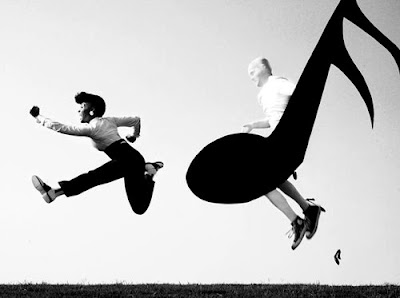
Janelle Monae, recently (or perhaps not so recently) signed to Bad Boy Records, does just that. Her 2008/2009 musical endeavors tell the story of Cindi Mayweather, an android who is hunted down by the futuristic Metropolis police for falling in love with a human. The video for the single "Many Moons" takes place at an android auction, where Monae plays the role of Mayweather performing for the bidders amongst dozens of robots that look just like her. And it seems that most of her success, already taking into account a uniquely powerful voice combined with music that sounds right off an Outkast album, comes from her ability to combine these fictional tales with the funk of past soul singers. Our radios are currently dominated by pop lyrics about love, cheating, and nights out on the town. We watch video after video of a generic front woman scantily clad in front of a microphone. In this kind of environment, Monae's quirky personality is refreshing. She caters to our aural sensibilities, but also shows glimpses of this cyborg future in the stars that we dream about.

I don't think it's a stretch to see music and science combined successfully like this, but I would be curious to see the full potential of her influence with more exposure. Unfortunately Diddy isn't so adept at recognizing actual talent.

Altering Our Emotions

Commercials can be very emotionally manipulative. Through the use of certain music and visuals commercials can make viewers feel happy about their products so that they will go out and by them. What is interesting about commercials for prescription medicines is that the product itself is designed to alter the emotions of the user. In the below ad for a depression medication, a woman would like to wind herself up and make herself more robotic. I think this could relate to what Rosie's group was saying today about the Svedka vodka robot girl and its relations to how men would like women to be more robot and suppress their complicated emotions.


I think people are skeptical of whether or not medications are a good or bad thing and I think people are actively questioning whether or not what scientists tell them is always the best thing for them. I myself tend to automatically assume that anything a scientist or a doctor would tell me would be the truth and should be trusted. At the same time I am suspicious of medicines that offer to make all sorts of problems disappear. I think the problem for me is that either I cannot believe that these medicines can do what they really say or that maybe they can but their effects are really unnatural. I think as long as people are discussing whether or not these medications are really necessary for them, then the emotional manipulation in these advertisements will hopefully have less effect.

Science and visual culture


This week we talked about science and visual culture and what better place
to look for the inspiration for this post than the Technology, Entertainmne,
Design (TED) website. After brief research, I came across one of the TED
talks posted on the website that was given by Ed Ulbrich, one of the
leading scientists working on The Curious Case of Benjamin Button. Many
of us know that the film was groundbreaking in terms of the technology
that was incorporated in the production. As he explains in this video, 155
people all involved in ditigal technology industy worked on the project for
nearly two years. Ulbrich proceeds that the first half of the film displays a
computer-generated character, which looks so real. Apparently, the
making of this film was postponed a few years ago due to the absence of
technology that could realize the complexities of the plot and the vision
of the director and producer.

This film generates some questions. We all know that computer-generated
characters were often used in many different films, however, this case is
very different, for the mere fact that due to the new technological
innovations and creativity, the Brad Pitt character looks very real at
the age of 87, even though, the facial mimics that it displayes belong to
Brad Pitt. This means that it is no longer necessary for the casting
managers to look for actors and actresses of different ages who have
identical features in order to show aging of a person in a film. It is also
worth mentioning that the computer-generated head of an old man was
placed instead of a body-actor’s face. Since, the face of an actor was
going to be replaced with this 3D head, it did not matter who would be
the body-actor. For this reason, Brad Pitt only got involved in the acting
when he had to play a character closer to his own age.

The question than becomes: What if, in about 20 years, the filmmakers,
since it is now possible to create real-looking computer-generated
characters, only used this method to make films? What kind of impact
would that have on actors and acting in general? If they advance this
technology to the point where it is unneccessary to have real-actors act,
will people react the same way to these imaginary, virtual actors and
actresses as they do to the real ones? Will this challenge the criteria for
being a celebrity.